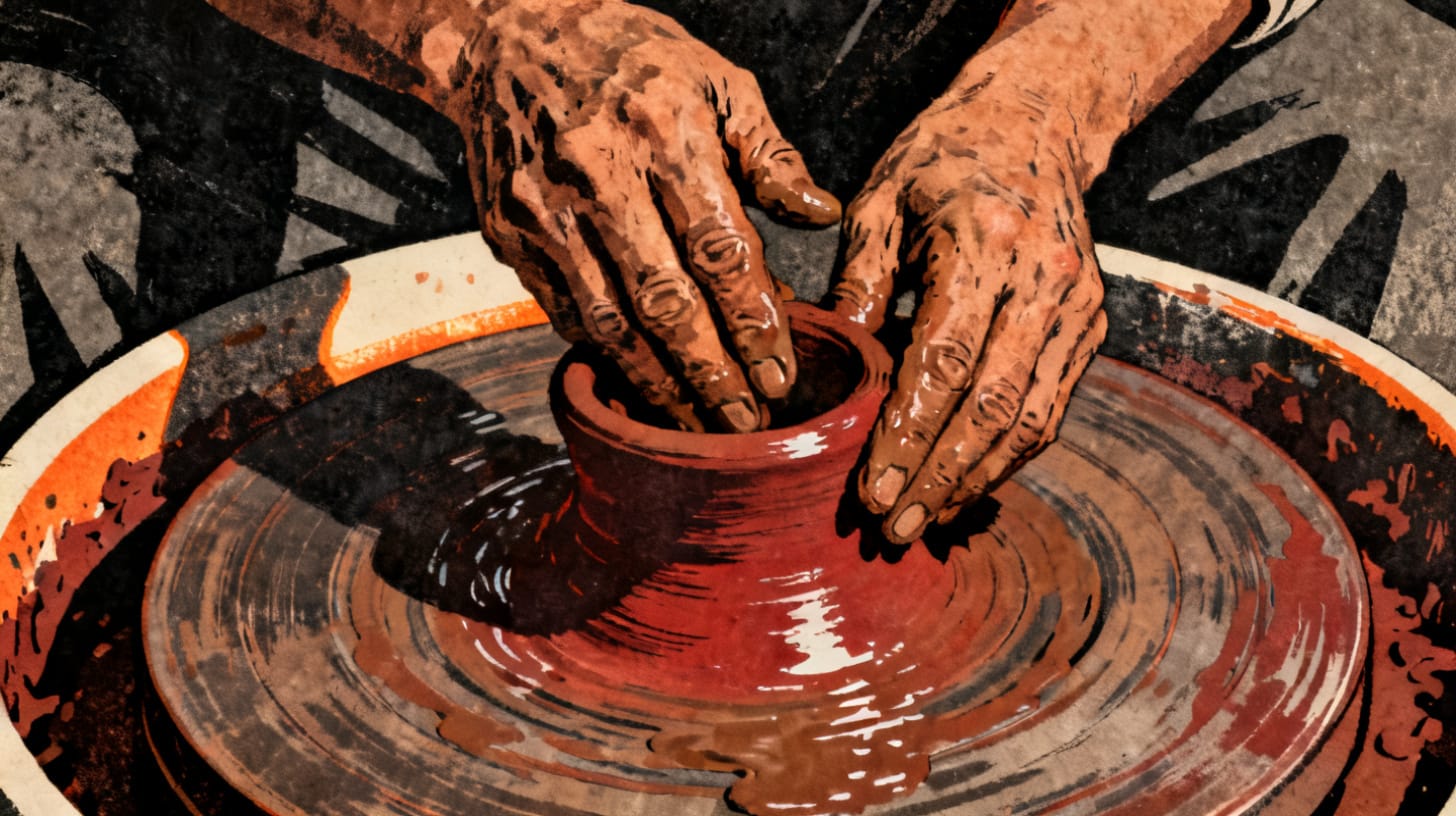
A potter friend once told me the wheel teaches you patience whether you want it or not. You cannot make the clay go faster. Push too hard and the wall thins on one side, the whole thing wobbles, and it collapses into a wet ring under your hands. The clay sets the pace. Your job is to listen to it, to feel the moment it is ready to rise, and to keep your hands steady through the long minutes when nothing visible is happening.
What struck me was the word she used. Not "skill." Listen. She had spent fifteen years learning to hear a lump of mud.
I think about this often now, because we have built machines that do not listen to the clay. They have no clay. You describe the bowl and a bowl appears, fully formed, glazed, photographed in soft light. It is, frequently, a perfectly good bowl. And I do not want to spend these words pretending otherwise, because the easy version of this essay — the one where craft is sacred and the tools are profane — is both boring and untrue. The tools are very good. That is exactly the problem worth thinking about.
the friction was the teacher
Here is the thing nobody tells you about doing something badly for a long time. The badness is not wasted. Each failed bowl taught my friend's hands a specific lesson her mind could not have learned by reading. Too wet. Too fast. Centered wrong. The collapse was information, delivered through her fingers, and after enough collapses she stopped needing to think about it. The knowledge had moved into her body.
This is what we mean by taste, though we rarely define it that plainly. Taste is not a preference you are born with or a vibe you absorb from good museums. It is a trained capacity to tell the difference between a thing that is almost right and a thing that is right, and to feel the gap as something close to physical discomfort. You acquire it the only way it has ever been acquired: by making the almost-right thing yourself, hundreds of times, and being forced to sit with how it falls short.
The friction was never in the way of the learning. The friction was the learning.
taste is the trained ability to feel the gap between almost-right and right, and that feeling is only ever installed by friction.
I learned to write by writing badly and then rewriting, which is a slower and more humiliating process than anyone admits at dinner parties. The fourth draft is where you discover the second draft was lying to you. Most of what I know about a sentence I know because I once wrote the worse version of it and something in me, some instrument I did not consciously build, said no. That instrument was assembled out of thousands of small frictions. Every one of them slowed me down. Every one of them was the point.
what the machine removes
Now consider what changes when the bowl arrives instantly.
The output is there, often good, sometimes excellent. But the loop that used to run between you and the failed attempt has been cut. You did not center the clay. You did not feel it go wrong. You typed, and a result the quality of years of practice appeared in seconds, and you kept none of the practice. You got the bowl and lost the fingers.
For someone who already has the fingers, this is a large gift. A trained potter who can already hear the clay can now produce at a speed that would have seemed like sorcery a decade ago, and her taste is still there to judge every result, to reject the nine bowls that are merely fine and keep the one that is alive. The machine multiplies the discernment she spent fifteen years building. It cannot give that discernment to someone who skipped the fifteen years.
And this is the quiet danger, the one that does not announce itself, because the early results look so good. A generation can now produce competent work without ever building the instrument that knows whether the work is actually any good. They will ship the fine bowl, because to an untrained eye fine is indistinguishable from excellent. The gap that taste lives in is invisible to anyone who has not been trained to feel it. You cannot miss a discomfort you have never been taught to have.
So we arrive somewhere genuinely strange. Capability has become cheap and abundant. Discernment has become rare and, worse, harder to acquire, because the friction that used to manufacture it has been removed in the name of helping us.
the people who will matter
I am not arguing that you should make things the slow way out of nostalgia, or that struggle is noble for its own sake. Struggle for its own sake is just inefficiency wearing a costume. The argument is narrower and, I think, harder to dismiss.
The scarce resource in an era of instant output is not the ability to make things. It is the judgment to know which made thing is worth keeping. And that judgment has only one known supplier: time spent in the friction, making the almost-right thing yourself, learning in your hands what the difference feels like.
The people who will matter most over the next decade are not the ones who can prompt the fastest. They are the ones who already learned how to wait for something to be good, who built the instrument while the friction still existed, and who can now stand in front of the machine's effortless output and say, calmly, no, not yet, again. They are the editors of the abundance. Everyone can generate now. Almost no one can tell.
The hopeful reading is that this makes taste more valuable than it has ever been. The market will be flooded with the fine and the competent, the technically correct and the quietly dead. The work that breathes will become easy to spot precisely because it will be so rare, and it will command a premium that scales with the flood. Slowness, the old unfashionable thing, turns out to be where the value was hiding the whole time.
So keep your hands on the wheel a while longer than you need to. Not because the machine is wrong, but because the clay is still the only thing that ever taught anyone to listen, and you will want to have learned how before you let it go.