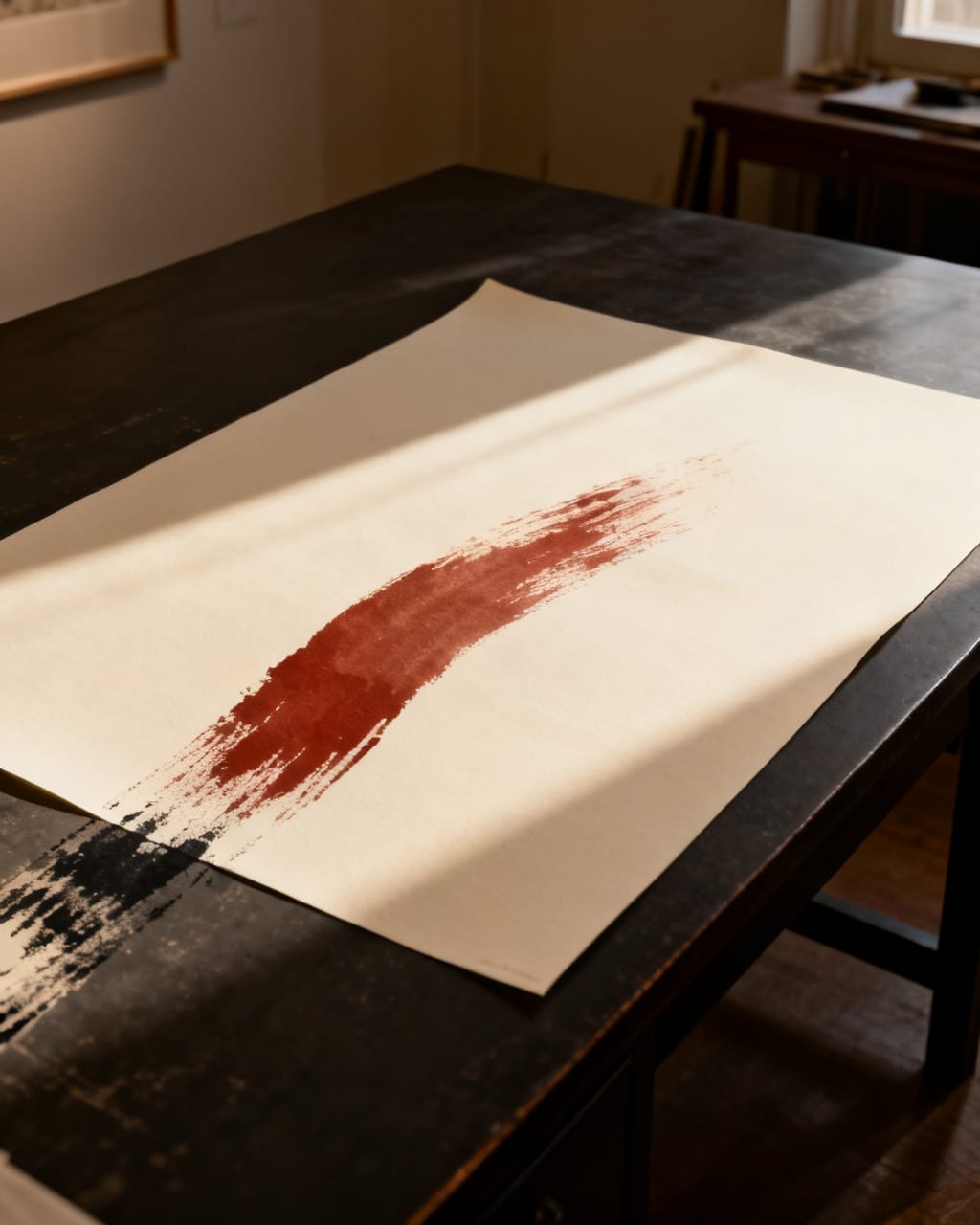
Hemingway kept a ritual for the blank page. He stopped work each day mid-sentence, at a point where he knew what came next, so the next morning he had something to walk toward instead of a white field. The trick was famous because the problem was universal. For roughly five centuries, ever since cheap paper made writing something ordinary people did, the hardest moment in any creative act was the first one: the gap between meaning to make something and having anything at all on the surface in front of you.
That gap is gone. Not narrower. Not easier. Gone. You can sit down today with no idea, no opening line, no thumbnail sketch, and within seconds have a full draft of an essay, a finished image, a working melody, forty alternate titles. The thing every maker dreaded for half a millennium has quietly been removed, and almost nobody is talking about what that does to the work.
the friction was load-bearing
Here is the uncomfortable part. The blank page was not only an obstacle. It was a filter, and we never noticed it was a filter because we hated it so honestly.
The cost of starting did real work. It meant that before anything existed, you had already paid something for it. You had sat with the discomfort long enough that only the ideas you genuinely cared about survived the wait. Most bad ideas died on the blank page, not because anyone judged them, but because nobody could be bothered to push them past the friction of beginning. The empty page was a tollbooth on the road to existence, and the toll was your attention. It quietly killed the projects you did not mean.
Take the toll away and everything gets through. Every half-thought, every shower idea, every faint impulse can now become a finished artifact in the time it takes to describe it. The supply of made things is no longer limited by the difficulty of making them. It is limited only by the number of prompts you can think to type, which is to say it is barely limited at all.
When everything can be made, the question is no longer can you, but should this exist at all.
from the empty page to the full one
So the terror does not vanish. It moves.
The old fear was vertical: a single white rectangle and your own inadequacy in front of it. You against nothing. The new fear is horizontal, and it is worse. You sit down and the machine hands you nine versions of the thing, all competent, none clearly right. Then you ask again and it gives you nine more. The blank page has been replaced by an infinite scroll of plausible, finished, forgettable pages, each one good enough to ship and none good enough to matter.
This is harder than the blank page, and we should be honest about why. The blank page asked one question you could not avoid: do I have anything to say? You either pushed through or you did not. The full page asks a question you can dodge forever: of these many acceptable options, which is actually good? Acceptable is the trap. Finishing something used to be proof you cared enough to finish it. Now finishing proves nothing. The artifact arrives unearned, and you are left holding it, unsure whether it deserved to arrive.
the new scarce skill is the no
What is scarce now is not making. It is selection. Knowing what is worth making at all, and then, among the things you have made, knowing which to keep and which to delete without sentiment.
This was always the editor's skill, and editing was always the underrated half of any craft. The painter who knows when the painting is finished. The cook who throws out a good sauce because it is not the right sauce. The writer whose best decision all week was the paragraph she cut. We praised the production and quietly relied on the judgment, because production was the visible, effortful part and judgment looked like doing nothing. Now production is free and judgment is everything, and the people who make anything that lasts are the ones who can stand in front of a hundred finished options and reject ninety-nine of them for reasons they can name.
Taste, in other words, was always doing more work than we credited it for. We could not see it, because it hid behind the labor of making. When making was hard, a person with mediocre taste and high stamina could still produce respectable work; the friction protected them, smoothed their output, forced a slowness that doubled as quality control. Remove the friction and the protection goes with it. Taste is now exposed, the only thing standing between a person and an ocean of competent noise. You can no longer hide a thin point of view behind the difficulty of expressing it.
what this asks of a maker
The practical shift is strange and a little lonely. The hours you used to spend grinding out a first draft are returned to you. The question is what you do with them.
The wrong answer is to make more. More is the path of least resistance and it leads nowhere worth going; the world does not need another thousand acceptable essays, and neither do you. The right answer is to spend the returned hours on the part that was always the real work and was always shortchanged: deciding what is worth your name. Sitting with an idea long enough to know if you actually believe it. Killing the versions that are merely fine. Building the one conviction that makes your no's worth listening to, because a no is only valuable if it comes from somewhere.
There is a quiet freedom in this, if you can stand it. For five hundred years a lot of human creative energy went into a problem that turned out to be a tooling problem, and the tooling has been solved. We can stop romanticizing the struggle to begin. The struggle to begin was never the point; it was the tax we paid to reach the point. What is left, now that the tax is abolished, is the harder, older, more human question the blank page hid: what is worth bringing into the world.
The empty page asked whether you could fill it. The full page asks whether you should have. That is a better question. It was always the better question. We just finally have to answer it.