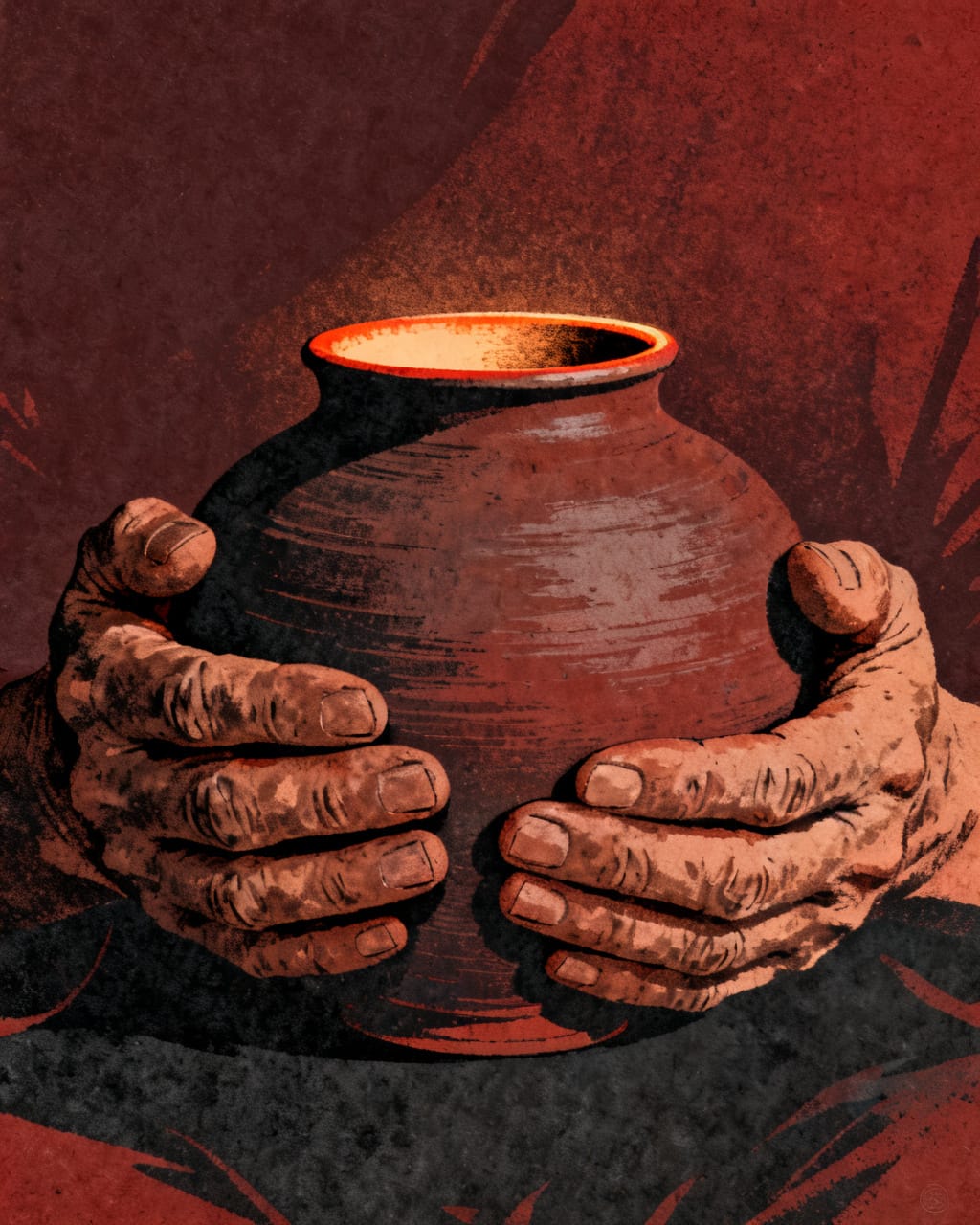
A surgeon I know can tell, with the tip of a scalpel, the difference between healthy tissue and the early edge of disease. Not by looking. By a change in resistance so slight it has no name, a faint difference in how the blade wants to move. Ask her to explain it and she goes quiet, then says something unhelpful like "it feels wrong." She has done this ten thousand times. The knowledge is real and reliable, and it lives somewhere she cannot point to and cannot put into words. It lives in her hands.
This is not a romantic claim. It is a precise one, and it has a name. In 1966 the chemist and philosopher Michael Polanyi opened a small book, The Tacit Dimension, with one sentence that has been quietly true ever since: "we can know more than we can tell." He meant it literally. There is a whole class of knowledge that never made it into language, not because no one bothered to write it down, but because it was never the kind of thing language could hold.
the face you cannot describe
Polanyi's favorite example was the plainest one. You can recognize a particular face among a thousand others, instantly, with total confidence. Now describe that face precisely enough that a stranger could pick it out of the crowd. You can't. The knowing is complete and the telling is hopeless, and the gap between them is not a failure of effort. It is the shape of how a mind actually works.
He thought all knowledge sat on top of this hidden layer: the expert's skill, the scientist's hunch about which experiment is worth running, the way you keep a bicycle upright without the faintest idea of the physics you are solving with your spine. He had a careful account of the mechanism. When you use a hammer, your attention is not on your palm. It is on the nail. The feeling in your hand is real, but you attend from it, to the work. The tool, and eventually the skill itself, becomes part of you, the way a blind man's cane stops being a thing he holds and becomes the place where he feels the pavement. Knowledge like this is not stored as facts. It is dwelt in, like a body.
a model is the largest collection of what can be told ever assembled. its blind spot is everything that can only be known.
the trap of "we know more than we can tell"
It is tempting to reach for Polanyi as a comfortable weapon against the machines, and the reach is half wrong, so it is worth getting right. He was not saying tacit knowledge is mystical, or that it can never be made explicit. He spent his life arguing the opposite: that even the most formal science floats on a sea of unspoken judgment, hunches, and trained perception that the scientist could never fully write down. His point was structural, not sentimental. The act of knowing always relies on things we are not attending to and could not articulate even if we tried. Subsidiary awareness, he called it, in service of a focal one.
Here is why that matters now. A language model is, in the most literal sense, a monument to the tellable. It is built entirely from what humanity wrote down, the explicit residue we managed to get into words. It is the largest collection of told things ever assembled, and on the tellable it is genuinely astonishing. But Polanyi's whole argument is that the told is the thin surface of the known. The model has perfect access to the surface and no access at all to what the surface is resting on, because that part was never written, because it could not be.
the cook does not measure
Watch a good cook who has stopped using recipes. She salts by sound, by the way the pan answers, by a smell that arrives a second before the garlic would have burned. She is not following rules she has memorized. She is responding to feedback through senses that took years to calibrate, in a loop so fast and so far below language that calling it "intuition" is just admitting we have no better word.
A model can read every cookbook ever published. It can tell you, with real fluency, that you cook the garlic until fragrant but not brown. What it cannot have is the nose that knows the exact half-second of fragrant-but-not-brown in this kitchen, this pan, this batch of garlic that is a little older than the last. That knowledge was never in any cookbook. It was never in language at all. A body acquired it standing at a stove, getting it wrong, smelling the burnt garlic, and slowly tuning an instrument that no one, including the cook, can read out and hand to someone else.
This is the part the machine cannot route around, and it is not a question of scale. More text will not help, because the missing knowledge was never text. You cannot photograph the smell of almost-burnt. You cannot transcribe the precise resistance the surgeon's blade meets, or the moment the clay on the wheel begins to thin under a potter's thumb and a thousand collapsed bowls have taught her to ease off, now, before it goes. That information exists. It is just stored in the only medium that ever held it, which is a trained nervous system, reached only by living inside a task with stakes and a body that pays for the mistakes.
the body was doing real work
The convenient version of this argument ends in triumph: the machines will never have hands, so the craftspeople win. That is too easy, and it is not quite what follows. Most economically valuable work is not surgery or pottery. Much of what we do all day really is the manipulation of explicit, tellable things, and on those the model will keep getting better, faster than is comfortable to watch.
The more interesting consequence is quieter. For a long time we have treated the body as a delivery problem, the slow analog wrapper around the real work of thinking, something to optimize away. The model is the purest disembodied intelligence ever built, a mind with no nose, no wrist, no pavement under a cane, and it turns out the body was not the packaging. It was doing a kind of knowing that the mind, on its own, simply cannot do. The hand was not carrying the knowledge to the brain. The hand was part of the knowing.
So the surgeon's quiet "it feels wrong" is not a charming limitation we will one day digitize away. It is a report from a layer of reality the disembodied cannot reach, the layer Polanyi spent his life pointing at. We can know more than we can tell. We are about to spend a great deal of money discovering, expensively, exactly how much more.