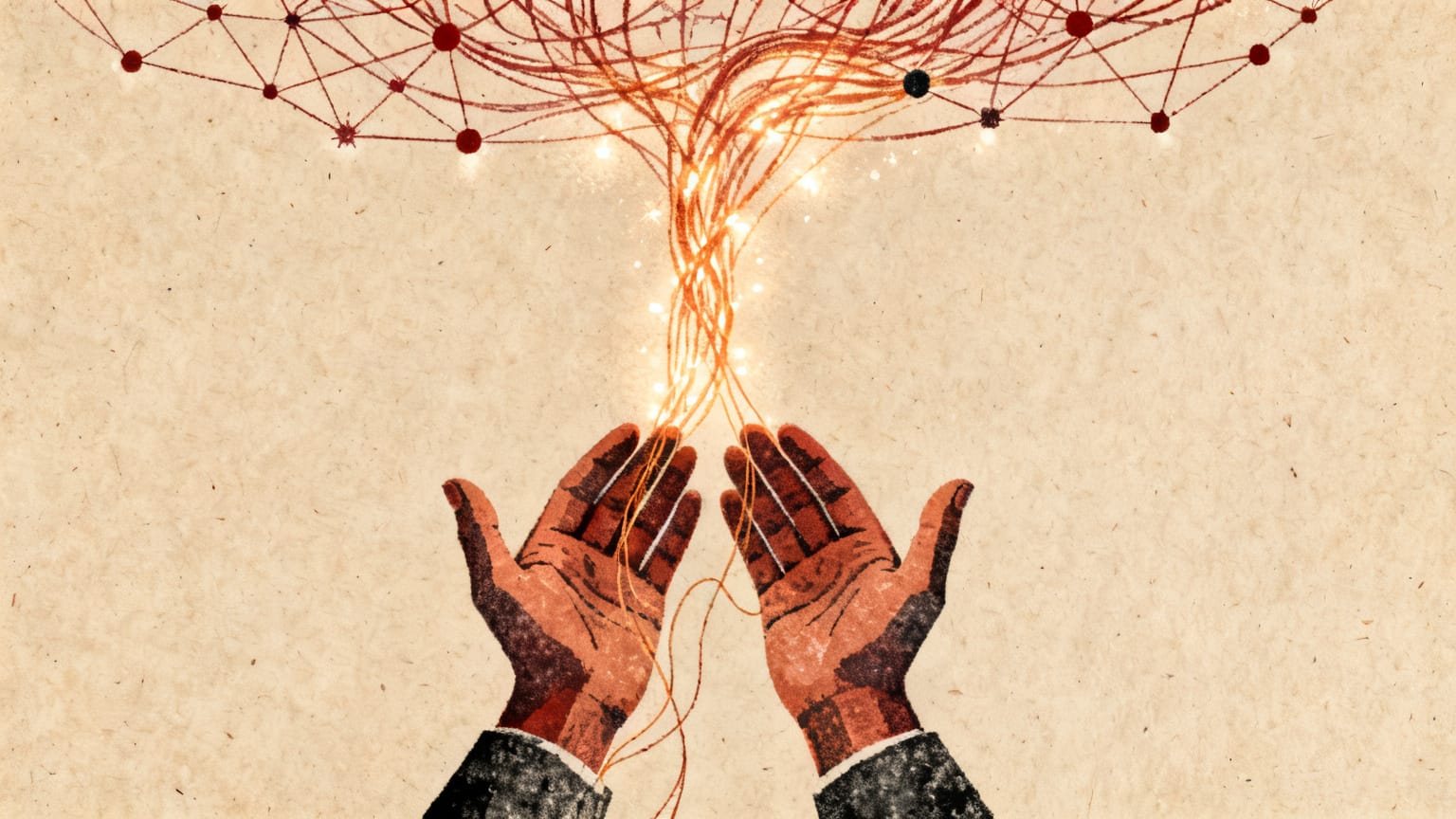
For most of human history, the bottleneck was making the thing. You wanted a portrait, a contract, a working prototype, a song that held together, a passable essay. Between you and that artifact stood hours, skill, and money. The artifact was scarce because the labor to produce it was scarce, and we built whole economies on that single fact. We built whole identities on it too. To be a maker was to own a stretch of the gap between wanting something and having it.
This year the fact quietly stopped holding. Not for everything, not perfectly, but enough that you can feel the floor move under you. The marginal cost of a competent draft is falling toward the cost of asking. Same for an image, a function, an argument, a melody. A request, a few seconds, and there it is. The thing that used to cost a week now costs a sentence.
When that happens, the instinct is to ask what the machine can make. We already know the answer. Nearly anything: at first badly, then instantly, then well enough that the difference stops mattering to most people. That is the boring question, and chasing it leads to the same dead-end argument everyone is having. The question worth your attention is the inverse one. As making becomes free, what becomes expensive? What stays scarce when supply goes infinite?
the floor was always the thing
It helps to see how strange the old arrangement was. For centuries, the cost of production was so high that it swallowed almost every other consideration. A publisher's real product was not judgment about which books deserved to exist. It was the printing press and the trucks. A studio's edge was not taste; it was the soundstage and the union crew you could afford to keep waiting. The expensive part was the doing, so the doing is what we measured, paid for, and respected. Quality was real, but it rode along on top of capacity. You could not get the good version without first being one of the few who could get any version at all.
That arrangement made a particular kind of person valuable: the one who could execute. The illustrator who could actually render the hand. The engineer who could actually ship the feature. The copywriter who could turn a brief into clean sentences by Thursday. Execution was the moat, and for a long time it was a wide one.
The water in that moat is draining. Not because execution stopped mattering, but because it stopped being scarce. When a thousand people, or one person with a few prompts, can produce the rendered hand and the shipped feature and the clean sentences, the moat is just wet ground. Anyone can walk across.
when execution is free, the value doesn't disappear. it backs up into everything execution used to hide.
what got more expensive
Here is the part nobody quite says out loud, because it sounds too convenient. The value did not vanish. It moved. It backed up into a small set of things that execution used to obscure, and those things got more expensive precisely because the easy part got cheap.
Judgment got more expensive. When a model will hand you forty plausible options in a second, the act of choosing becomes the work. Knowing which of the forty is actually good, and being able to say why, and being willing to throw out thirty-nine things that took no effort to make and feel a little wasteful to discard. The bottleneck used to be generating the options. Now the options are free and the bottleneck is having a reason. Taste stopped being a finishing move applied at the end of a project. It became the load-bearing wall.
Attention got more expensive, in two directions at once. Yours, because the cost of asking for more output is now so low that you can drown yourself in your own production, churning out drafts until you have a hundred of them and no idea which problem you were solving. And the audience's, because everything now competes for it on equal, frictionless terms. When anyone can make a polished thing, polish stops being a signal. The reader's attention, which was already the scarcest resource, becomes the only one that was never inflated.
Care got more expensive, and this is the quiet one. Care is the willingness to stay with a thing past the point where it is merely adequate. The machine, by design, stops at adequate. It has no reason to keep going; adequate is its whole target. The extra hour. The version nobody asked for. The detail only one reader in a thousand will notice. The decision to cut the clever part because it served the writer and not the reader. None of that is in the cost curve. It comes only from a person who has decided that this particular thing is worth more than the effort it strictly requires. When making was expensive, care was hard to distinguish from labor. Now that making is free, care is the only labor left, and it stands out like a lit window.
these are postures, not skills
The thing to notice about judgment, attention, and care is what they are not. None of them is a technical capability. You cannot install them, license them, or fall behind on them the way you fall behind on a framework. They do not have version numbers. A model will not ship an update next quarter that makes your taste obsolete, because your taste was never a feature it was competing with.
They are human postures. Stances a person takes toward their work and the people on the other end of it. And that is the hopeful part hiding inside what looks, from the outside, like the floor falling out of every creative profession at once.
If the value had moved into some new technical skill, we would all be back on the treadmill, racing to acquire it before the machine did, and losing. But it moved somewhere the machine cannot follow. A model can counterfeit the output of judgment, the chosen option, but not the judging. It can imitate the look of care, but care is a relationship, and there is no one home on its side of it. The thing it cannot counterfeit is a person bothering to mean something.
That was always the real work. For most of history it was wrapped inside the labor of making, hard to see and harder to charge for separately, so we mistook the wrapping for the gift. Now the wrapping is free and you can see clearly what was inside the whole time.
When making becomes free, the maker is not left worthless. The maker becomes the one part of the process that was never about making at all. The taste to choose, the attention to notice, the care to stay. Those were the expensive things underneath. We just couldn't see them while the cost of everything else was so loud.